
How Do Weapons Detection Systems Work in Schools?
Creating a safe learning environment is one of the most important responsibilities school administrators and district leaders face. While schools have traditionally relied on secured entrances, surveillance cameras, and established emergency procedures, advances in security technology now provide additional ways to identify potential threats and support timely responses. Weapons detection systems have become an increasingly important consideration for K-12 districts looking to strengthen their overall campus safety strategies.
But how do these systems actually work, and what should school leaders understand before introducing them into their facilities? Today’s weapons detection technologies range from physical screening equipment at school entrances to artificial intelligence software that analyzes surveillance footage for visible firearms.
Understanding these differences can help administrators make informed decisions about protecting students, supporting school personnel, and maintaining a welcoming educational environment. At Communications Technologies, Inc. (CTI), we help districts evaluate and implement security solutions designed around their specific campuses, operational requirements, and existing infrastructure.
1. Understanding Weapons Detection Systems for Schools
Weapons detection systems for schools use specialized technologies to identify certain potential threats and notify designated personnel when further evaluation may be necessary. Depending on the equipment, these systems may screen people entering a building or analyze video footage from cameras positioned throughout a campus.
Although the technologies differ, their purpose is similar: providing school security teams with additional information that supports established safety procedures.
How Physical Weapons Screening Works
Physical weapons screening systems generally rely on sensors that identify metallic objects passing through a designated screening area. Traditional walk-through metal detectors respond to metal, while more specialized screening technologies are designed to identify particular categories of metallic threats.
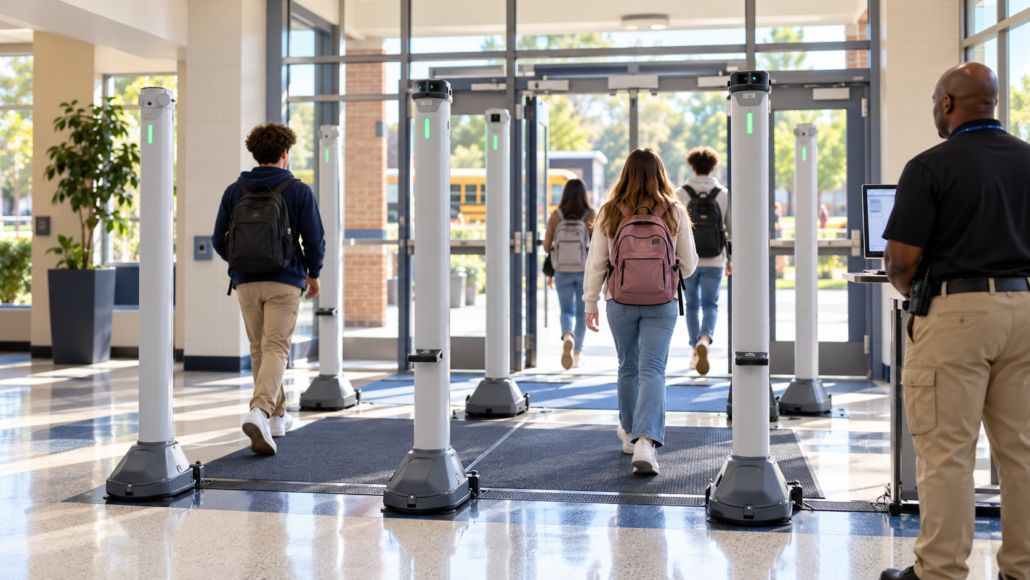
For example, CTI offers OPENGATE, a portable weapons screening system designed to detect certain high-risk metallic threats while accommodating people carrying everyday belongings. Its two self-powered pillars establish a screening passageway without requiring a physical connection between them.
When the system identifies an object meeting its detection criteria, audible and visual indicators notify nearby personnel. Staff can then follow established procedures to determine whether additional screening is necessary.
Importantly, detection capabilities vary by manufacturer, system configuration, and object characteristics. School administrators should evaluate precisely what each system is designed to identify rather than assuming all screening technologies detect the same items.
Why Schools Are Considering Advanced Detection Technology
K-12 facilities present operational challenges that differ considerably from those of airports or entertainment venues. Large numbers of students may arrive within relatively short periods, and entrances must accommodate backpacks, school supplies, mobility devices, and other everyday belongings.
School districts therefore need security measures that support effective screening without unnecessarily interrupting daily operations. Modern systems can help address these considerations when paired with appropriate staffing, training, and entry procedures.
2. How Walk-Through Metal Detectors Screen Students and Visitors
Walk-through screening equipment creates a designated area where students, employees, and visitors can be assessed as they enter a building. These technologies are commonly positioned near main entrances, although their placement depends on campus layouts and security procedures.
Understanding how different screening systems operate helps school administrators select appropriate equipment for their facilities.
Traditional Metal Detection Versus Advanced Weapons Screening
Conventional walk-through metal detectors generate electromagnetic fields that respond to metallic objects. When someone passes through carrying sufficient metal to trigger the configured sensitivity threshold, the equipment generates an alert.
However, conventional systems may also respond to ordinary belongings such as keys, electronic devices, and other metallic items. This can result in additional screening that requires time and staff attention.
Advanced weapons screening equipment may use specialized detection methods and algorithms to distinguish certain threat-related metal signatures from common personal belongings. For instance, CTI’s OPENGATE system is designed for higher-throughput screening without routinely requiring individuals to remove everyday items.
These capabilities depend on the specific equipment and its operating settings. No physical screening system should be assumed to identify every possible weapon or prohibited object.
Maintaining Efficient Campus Entry Procedures
Operational efficiency is particularly important during morning arrival, athletic events, and other periods when large groups enter school facilities.
Portable screening equipment can offer flexibility for districts managing multiple entrances or temporary events. CTI’s OPENGATE system, for example, features a self-powered, wire-free configuration that can be relocated as screening requirements change.
School administrators should also consider accessibility, staffing responsibilities, secondary screening procedures, and how alerts will be handled discreetly and consistently. Effective implementation requires more than positioning equipment near a doorway.
3. How AI Weapons Detection Uses Existing Security Cameras
While physical screening equipment evaluates people passing through designated entrances, AI weapons detection uses video analytics to examine camera footage for recognizable visual indicators of firearms.
This distinction matters because the two technologies provide different types of information and address different security needs.
Understanding AI-Powered Firearm Recognition
AI-powered firearm detection software analyzes video images using computer vision models trained to recognize visual characteristics associated with firearms.
When a potentially relevant object appears within a camera’s field of view, the software can generate an alert for further evaluation. Depending on the platform, alerts may include a camera location, recorded images, or corresponding video footage.
CTI offers AI-assisted firearm detection solutions, including technology from Omnilert, that can work with compatible IP-based surveillance cameras. These systems are designed to help identify visible firearms and support predefined notification and response procedures.
Unlike physical screening equipment, camera-based AI generally cannot detect a firearm completely concealed from the camera’s view. Performance can also be affected by lighting, camera placement, image quality, obstructions, and the firearm’s visibility.
Turning Detection Into Actionable Information
Identifying a possible firearm is only one component of an effective response. School personnel also need reliable information and established procedures for evaluating alerts.
Depending on the system configuration, AI-generated notifications can be routed to designated administrators, security personnel, or monitoring teams for verification. Confirmed alerts may then support established emergency communication and response protocols.
For example, integrated systems can help initiate appropriate notifications or other predefined actions based on a district’s approved procedures.
Human oversight remains essential, particularly when determining whether an alert represents an actual threat. Schools should establish clear verification responsibilities and understand the potential for missed detections and false alerts.
4. Integrating Weapons Detection With Existing School Security Systems
Weapons detection technology becomes more useful when it operates as part of a coordinated campus security strategy. A detection alert provides information, but connected security systems can help administrators understand the situation and communicate with appropriate personnel.
Integration planning should therefore be a central consideration when evaluating new equipment.
Connecting Detection With Video Surveillance and Access Control
Video surveillance systems provide additional situational awareness by allowing authorized personnel to view entrances, hallways, common areas, and other monitored locations.
When compatible systems are integrated, a weapons detection alert may be associated with relevant camera footage. This gives security personnel additional context as they assess the situation and determine the appropriate next steps.
Access control systems provide another important layer of protection. These technologies help districts manage authorized entry, monitor secured access points, and establish different permissions for designated areas.
Integrating access control with detection and surveillance platforms can improve coordination, although compatibility and available functions depend on the specific products involved.
Supporting Emergency Communications and Staff Coordination
Clear communication is essential during any campus safety concern. Emergency communication systems help administrators share instructions with designated personnel and coordinate established response procedures.
Depending on a district’s technology infrastructure, integrated platforms may support notifications, communication with first responders, and activation of approved emergency protocols.
However, technology should reinforce rather than replace staff training and preparedness. Regular exercises, clearly defined responsibilities, and accessible emergency procedures remain fundamental components of school safety.
Schools should also address cybersecurity, privacy, video retention, and authorized access when connecting multiple security technologies.
5. Choosing the Right Weapons Detection Solution for Your School District
Every school campus operates differently, making a standardized approach to weapons detection difficult to apply effectively across all districts.
Building configuration, student population, entry procedures, existing surveillance infrastructure, and staffing availability all influence which technologies may be appropriate.
Evaluating Your Campus Security Needs
Before selecting equipment, school leaders should conduct a thorough review of their facilities and current security practices. This evaluation can identify screening locations, camera coverage limitations, operational concerns, and opportunities for integration.
District decision-makers should also consider how potential alerts will be verified, who receives notifications, and what actions personnel are authorized to take.
Technology demonstrations, realistic testing, and staff involvement can help schools evaluate usability and limitations before deployment. Ongoing maintenance and training requirements should also factor into long-term planning.
Strengthen Your School’s Security Strategy With CTI
At Communications Technologies, Inc., we understand that protecting a learning environment requires thoughtful planning, dependable technology, and solutions that fit the way your district operates. Since 1999, we’ve worked with organizations to design and implement communications and security technologies, bringing that experience to K-12 campuses nationwide. Our school security offerings include physical weapons screening, AI-powered firearm detection, video surveillance, access control, and integrated communication systems.
We work closely with administrators, facilities teams, IT professionals, and school safety leaders to understand their needs before recommending a system configuration. From initial consultation and installation to staff training and ongoing support, our goal is to help districts build practical, coordinated security solutions. Contact CTI today to explore weapons detection systems for schools and learn how our team can help strengthen your campus safety strategy while supporting a welcoming educational environment.



Leave a Reply
Want to join the discussion?Feel free to contribute!